


posted 6th October 2026
The strongest senior HR candidates do not judge an opportunity simply by the salary or job title. They notice how the organisation makes decisions, whether leaders agree on the mandate, how difficult questions are answered and whether the recruitment process reflects the culture they are being asked to shape.
That makes recruitment part of the assessment in both directions.
While an employer may believe it is taking appropriate care over an important appointment. A candidate may experience the same process as indecision, political misalignment or a sign that the role lacks real authority. By the time the organisation reaches a preferred candidate, that person may already have withdrawn, accepted another offer or decided the brief is not credible.
What can employers do about this?
It’s true that a clunky HR recruitment process can cost an employer its best candidates, particularly when the decisions move slowly, communication is inconsistent or the proposition does not match the reality of the role. So, the first thing that needs be in place in a strong, clear process and a structure that is both inclusive and decisive.
Why senior HR recruitment is different
A senior HR appointment often sits at the point where commercial ambition, culture, risk and leadership behaviour meet. The person may be expected to support growth, reshape capability, improve employee relations, lead transformation, strengthen governance or challenge an executive team.
Candidates therefore need more than a conventional job description. They need to understand:
- Which areas of the business they’ll be expected to influence
- Why the role exists now
- What is genuinely within its authority
- Who supports the mandate and where resistance may sit
- What resources, data and team capability are available
- How success will be judged and
- Whether the leadership team wants strategic challenge or mainly operational delivery.
If those questions are unresolved internally, a polished advertisement will not compensate. Experienced HR leaders are trained to recognise the gap between stated values and organisational behaviour.
Seven ways employers lose strong HR candidates
1. The organisation has not agreed what it is hiring for
One interviewer wants a strategic adviser. Another wants an operational problem-solver. A third expects a transformation leader but offers neither budget nor decision-making authority.
This creates shifting criteria and contradictory conversations. It also makes comparison unfair because candidates are effectively being assessed against different roles.
Before going to market, agree the central purpose of the appointment, the non-negotiable outcomes and which capabilities can be developed after appointment. Separate what the organisation needs from what each stakeholder personally prefers.
2. The title is senior, but the mandate is not
A candidate may be invited to discuss an HR Director or Chief People Officer role, then discover that the position has limited access to the board, no ownership of people strategy or an expectation to deliver change without executive sponsorship.
Be explicit about reporting lines, committee access, budget, team, decision rights and the relationship with the chief executive and board. If the remit is still evolving, say so and explain what can genuinely be shaped.
3. The timetable signals indecision
Good candidates can understand a robust process. What damages confidence is an unpredictable one: unexplained gaps, repeatedly moved interviews, extra stages added late or silence after substantial assessment.
Speed should not replace judgement. The answer is a planned process with named decision-makers, protected diary time, clear communication points and an agreed route for resolving disagreement.
4. Every interviewer runs a different assessment
Informal conversation has value, particularly at executive level, but it should not be the whole selection method. When questions and standards vary, confidence, familiarity or personal chemistry can displace evidence.
Use a structured scorecard linked to the actual mandate. Ask all shortlisted candidates a consistent core set of questions, define what strong evidence looks like and record independent assessments before the panel discusses them.
5. The assessment burden is disproportionate
Multiple presentations, lengthy unpaid projects and repeated retelling of the same career history can suggest that the organisation does not respect senior candidates’ time, or that they don’t know what evidence it needs.
Every stage should answer a distinct decision question. A relevant case discussion can be useful. A speculative assignment that resembles free consultancy is harder to justify. Explain the purpose, time expectation, audience and treatment of any confidential material.
6. The employer proposition collapses under scrutiny
Generic claims about being “people-first” will not persuade an HR leader if the evidence points elsewhere. Candidates will test leadership appetite, employee relations history, workforce data, previous change attempts and the resources behind the role.
Credibility comes from an honest account of strengths, constraints and work still to be done. The right candidate isn’t looking for the perfect organisation but they do need an honest, full picture they can evaluate.
7. Candidate communication becomes transactional
Senior candidates may be managing confidentiality, board relationships and notice periods while participating in a process. Poor updates or vague feedback can quickly erode trust.
Set expectations at the outset. Tell candidates when they will hear from you, who will contact them and what the next stage involves. If a decision is delayed, communicate the reason and the revised date rather than allowing silence to speak for the organisation.
What a credible senior HR recruitment process looks like
Every activity within the framework should have a clear purpose; from writing the advert, to engaging with the market; the assessment process to the offer stage and then the onboarding experience.
Build the brief before writing the advert
An effective senior HR brief should answer five questions.
- What is happening in the business? Growth, integration, restructuring, capability gaps, leadership change, cultural repair or increased regulatory exposure all create different requirements.
- What outcome must improve? Define the changes expected over the first 6, 12 and 18 months, while recognising that the successful candidate must validate assumptions after joining.
- What authority comes with the role? Clarify reporting line, board access, budget, team shape and decision rights.
- What evidence will distinguish candidates? Focus on demonstrated judgement and outcomes, not an unrealistic catalogue of sector labels and years of experience.
- Why should the right person join? State the opportunity honestly: the impact available, the support committed and the problems that remain unresolved.
The brief should also distinguish between essential capability and skills and experience that could benefit the role. An employer that makes every feature of the previous post-holder’s background mandatory may exclude people with more relevant transferable experience.
We would also recommend using one scorecard for every stakeholder involved. Set the weighting before interviews and ask interviewers to score evidence independently before group discussion. This does not remove judgement; it makes the basis of that judgement visible and easier to challenge.
Candidate experience is organisational evidence
At senior level in particular, a candidate will carry out their own due diligence based on their experience of the recruitment process.
They will observe whether:
- Leaders tell a consistent story about the organisation
- Difficult questions receive direct answers
- Meetings start prepared and on time
- Confidential information is handled carefully
- The organisation accommodates legitimate access needs
- Feedback and decisions follow the promised timetable; and
- The terms discussed throughout the process remain stable at offer stage.
These signals shape whether the candidate believes the organisation is being completely honest and whether they are a good fit.
Fairness, accessibility and responsible use of data
A high-quality process must also meet the employer’s legal and ethical responsibilities.
Acas states that employers must follow discrimination law throughout recruitment and make reasonable adjustments for disabled applicants or interviewees. UK government guidance gives examples such as accessible interview arrangements and allowing a candidate to complete a written test using a computer.
Employers should make the route for requesting adjustments clear at every stage.
Candidate information also requires careful governance. The Information Commissioner’s Office provides recruitment and selection guidance covering data-protection responsibilities, including the use of automated decision-making and AI. If technology supports sourcing, screening or assessment, the employer should understand what data is used, how outputs affect decisions, how bias and accuracy are tested, what candidates are told and how a decision can be challenged.
Technology can support administration and consistency, however, accountability for a senior appointment should not disappear into a tool or an unexplained score.
Questions strong HR candidates are likely to ask
Preparation should include credible answers to questions such as:
- Why is the role open, and what happened before?
- Which business decision has made this appointment urgent now?
- What does the chief executive expect the HR leader to challenge?
- Where do the board and executive team disagree about the people agenda?
- What are the most significant workforce, employee relations or capability risks?
- Which decisions will the role own, influence or advise on?
- What investment is already approved?
- How will success be measured after 12 months?
- What has made change difficult here in the past?
- What would cause the successful person to struggle?
Defensive or contradictory answers are informative. Resolving them before interviews improves both selection quality and organisational readiness.
How to improve the process without lowering the bar
- Hold a mandate session before search begins: Bring the decision-makers together and expose differences early.
- Appoint one process owner: Give one person responsibility for timetable, communication, evidence and candidate care.
- Agree the scorecard and weighting: Do this before anyone sees a candidate profile.
- Protect decision-maker diaries: Reserve assessment and debrief time in advance.
- Remove duplicate stages: If two conversations test the same thing, combine or redesign them.
- Share enough context for informed consent: Candidates should be able to evaluate the real opportunity and risk.
- Offer adjustments proactively: Make accessibility part of process design rather than an exception.
- Debrief from evidence: Compare candidates with the mandate, not with the most persuasive person in the room.
- Prepare the offer before the final stage: Resolve salary, flexibility, location, notice and approval constraints early.
- Carry the mandate into onboarding: The recruitment brief should become the starting point for sponsorship and priorities after appointment.
Measures worth tracking
Time to hire alone can reward speed without quality. However, a more useful dashboard combines pace, experience, fairness and outcome.
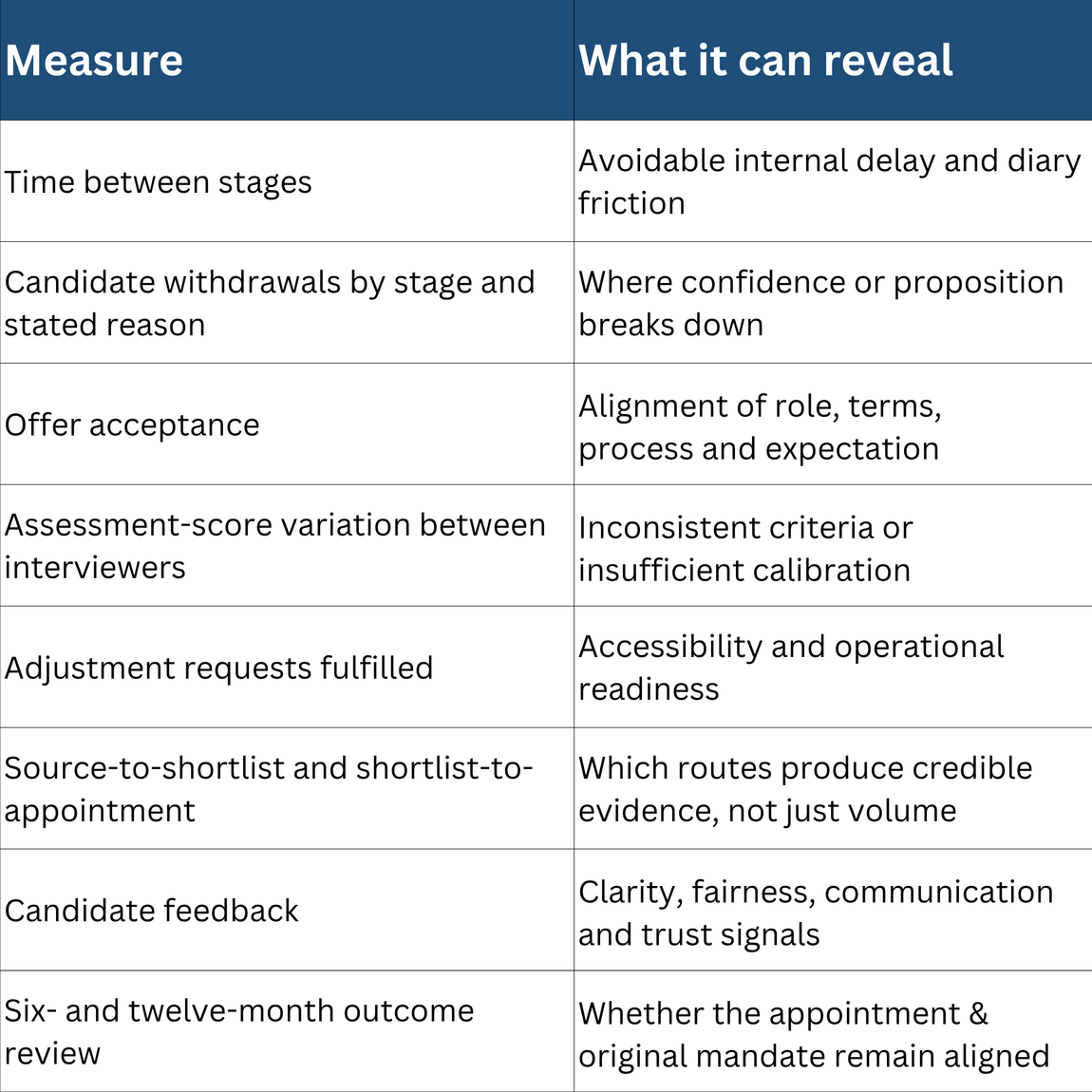
Handle monitoring data carefully. Equality information should have a clear purpose, appropriate access controls and suitable separation from selection decisions.
When specialist HR recruitment support adds value
If you’re preparing to hire a senior HR leader, the quality of your recruitment process will shape the quality of your shortlist. Executive HR can help you build a process that is clear, credible and aligned — long before candidates enter the room.
We work with organisations to:
- Test and refine the mandate so the brief is realistic, aligned and compelling
- Map the market beyond active applicants, reaching high calibre HR leaders who aren’t visible
- Present the opportunity with honesty and context, strengthening trust from the first conversation
- Structure assessment around consistent evidence, not preference or personality
- Maintain momentum and communication, protecting candidate experience and organisational reputation
- Surface concerns early, before they become late stage surprises
A senior HR appointment shapes culture, capability and leadership behaviour. It deserves a process that reflects that level of impact.
If you’re planning a key HR hire or want to improve how your organisation approaches senior HR recruitment speak to Executive HR for a confidential conversation about the mandate, market and recruitment strategy.
 A Vester Group Company